
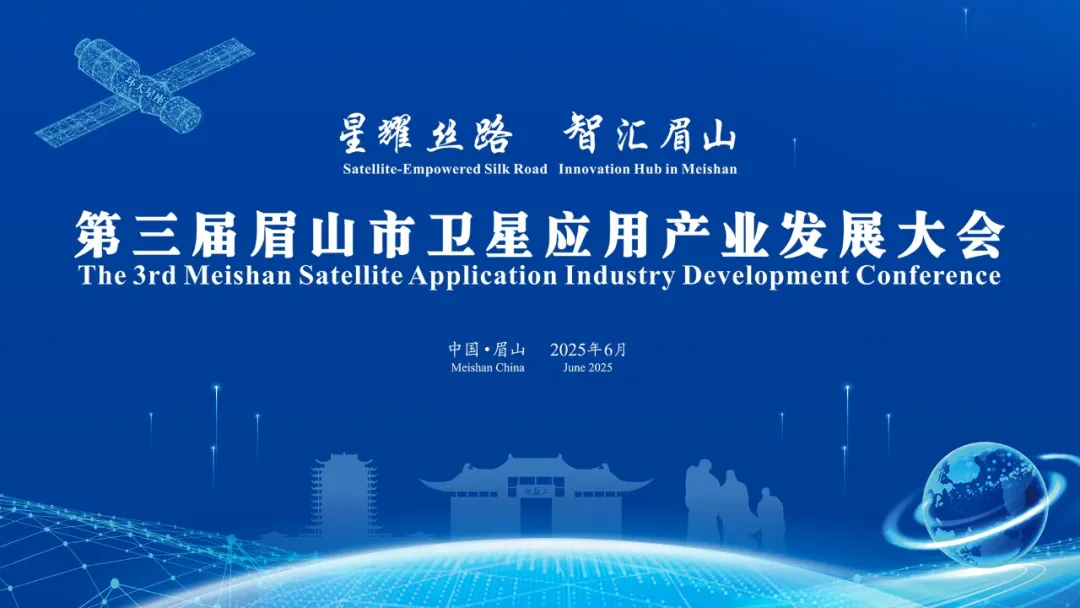
Meeting friends among the stars, and talking of the future among the stars. On 9 June, the 3rd Meishan Satellite Application Industry Conference opened in Meishan. Vice Governor Li Wenqing attended and delivered remarks.
Reporters learned at the conference that relevant enterprises in Meishan plan to launch 10 more satellites within this year. In recent years, Meishan has taken the lead in the province in laying out the satellite application industry, and has already completed first-stage networking of 10 high-resolution optical satellites of the Huantian Constellation.
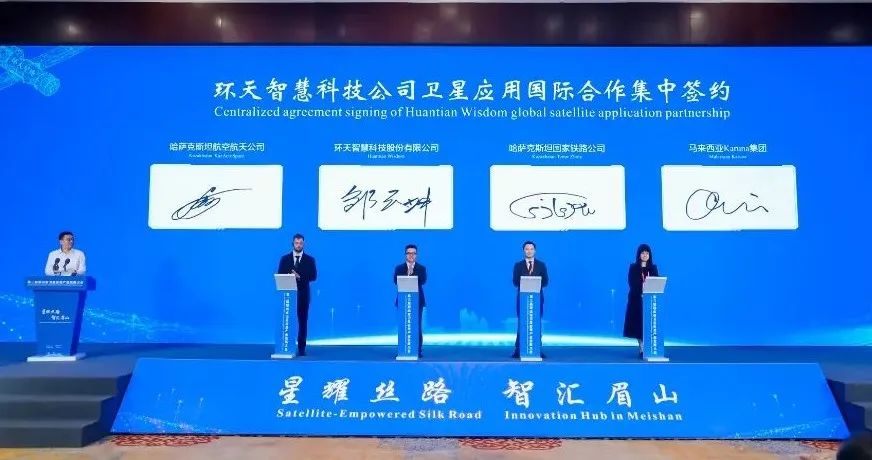
At the conference, 10 satellite-related industrial and fund projects were signed in a concentrated ceremony, with a value of RMB 7.335 billion, covering science and innovation platforms and satellite applications, and involving key links across the industrial chain including satellite manufacturing, operations and services, and data applications. An industrial cluster integrating R&D, manufacturing and testing will be built.
Under the theme “Stars over the Silk Road, intelligence gathering in Meishan”, the conference invited experts, enterprise representatives and heads of international cooperation organisations in remote-sensing science and technology, aerospace and related fields to discuss the future development of the satellite application industry.
The China Association of Remote Sensing Applications also released the Blue Book on the Development of China’s Remote-Sensing Applications (2025), summarising the year’s results and providing innovative ideas for the development of the satellite industry. Li Deren, a recipient of the State Supreme Science and Technology Award and a professor at Wuhan University, and Zhu Ninghua, a microwave photonics scientist and dean of the Institute of Intelligent Photonics at Nankai University, each delivered a keynote speech. Huantian Wisdom released Xingkan Heshan · Vision, a product that integrates more than 40 core spatiotemporal AI algorithms and achieves precise, efficient data interpretation.
The conference lasts two days, and the 2025 annual meeting of the China Association of Remote Sensing Applications is being held at the same time.
Which leading guests were invited to this year’s conference?
Sun Laiyan
He previously served as deputy director and director of the Beijing Institute of Spacecraft Environment Engineering and as a professor of spacecraft environment engineering, and has received a number of national and provincial and ministerial science and technology awards. In 1999 he became deputy director of the China National Space Administration. In 2001 he became secretary-general of the Commission for Science, Technology and Industry for National Defense and deputy director of CNSA. In 2004 he became vice minister of the Commission and administrator of CNSA. In April 2010 he became chairman of a supervisory board for key large state-owned enterprises.
Li Deren
A photogrammetry and remote-sensing scientist and a professor at Wuhan University. He is mainly engaged in research on geospatial information science, and is one of the pioneers of China’s high-precision, high-resolution Earth-observation system. He has received a first prize of the National Science and Technology Progress Award, a National Science and Technology Progress Award (innovation team), the Ho Leung Ho Lee Prize for Scientific and Technological Progress, was named one of the country’s “most beautiful scientific and technological workers” in 2021, and received the 2023 State Supreme Science and Technology Award. The International Society for Photogrammetry and Remote Sensing has awarded him Honorary Membership (its highest honour) and the Brock Gold Medal (its highest prize).
Tong Qingxi
A remote-sensing scientist and a researcher at the Institute of Remote Sensing and Digital Earth of the Chinese Academy of Sciences. He is mainly engaged in research on climatology, solar radiation and the spectral characteristics of ground objects in remote sensing, has advocated and carried out research on hyperspectral remote-sensing applications, and is one of the earliest pioneers in the application of remote-sensing technology in China. He has received national and provincial and ministerial science and technology progress awards, the SPIE “International Remote Sensing Science and Technology Achievement Award”, and an Asian remote-sensing contribution award and gold medal.
Zhang Zuxun
A photogrammetry and remote-sensing scientist and a professor at the School of Remote Sensing and Information Engineering, Wuhan University. He is mainly engaged in research on digital photogrammetry, has achieved world-class results in the automation of mapping from aerial (and space) imagery, and has introduced the independently owned digital photogrammetry system VirtuoZo, which has been widely used at home and abroad. He has received a second prize of the National Natural Science Award and a second prize of the National Science and Technology Progress Award, among others.
Luo Ge
Chair of the sixth council of the China Association of Remote Sensing Applications. He previously served as deputy director-general of the International Department and director-general of the First Department of Systems Engineering of the former Commission for Science, Technology and Industry for National Defense, deputy administrator of CNSA, and director-general of the Third Department of Systems Engineering of the State Administration of Science, Technology and Industry for National Defense. He has received a commemorative medal from the CPC Central Committee, the State Council and the Central Military Commission for the 70th anniversary of the founding of the People’s Republic of China, been named a national model worker in earthquake relief, and received a second prize of the National Defense Science and Technology Award, among others.
Gong Jianya
A surveying, mapping and geographic information scientist and a professor at the School of Remote Sensing and Information Engineering, Wuhan University. He is mainly engaged in basic research on geographic information theory and geometric remote sensing, has independently developed GIS basic software and a network service platform as well as a remote-sensing ground processing system, and has addressed major national needs. He has received a second prize of the National Science and Technology Progress Award, a first prize at provincial and ministerial level, and the Dolezal Award of the International Society for Photogrammetry and Remote Sensing (ISPRS), among others.
Zhu Ninghua
A microwave photonics scientist, dean of the Institute of Intelligent Photonics at Nankai University, and director of a Tianjin top-scientist studio. He is mainly engaged in research on microwave photonic devices and technology, and has achieved innovative results of important practical value in research on high-speed laser chips and modules and in exploring new mechanisms for optically generated microwaves. He has received two second prizes of the National Technological Invention Award, as well as the Outstanding Achievement Award of the Chinese Academy of Sciences (individual) and the Guanghua Engineering Science and Technology Prize, among others.
Tao Zhi
An aero-engine expert, a member of the Standing Committee of the 14th National Committee of the Chinese People’s Political Consultative Conference, a professor at Beihang University, dean of the Beihang Aero-Engine Academy (International School of Aero-Engines), and a former vice president of Beihang University. He is mainly engaged in research on the aerodynamics and thermodynamics of aero-engines, and is one of the leading figures in basic research on aero-engines in China. He has received a second prize of the National Technological Invention Award, a first prize of a provincial and ministerial science and technology progress award, and a first prize of the Ministry of Education Technological Invention Award, among others.
Hu Jun
Deputy secretary of the Party committee and president of the University of Electronic Science and Technology of China, a national-level high-level leading talent, a distinguished professor under the Ministry of Education’s Changjiang Scholars Programme, and a recipient of the National Science Fund for Distinguished Young Scholars. He has long been engaged in research on computational electromagnetics and electromagnetic radiation and scattering, has led more than 10 national key projects including 973 and 863 programmes, and has received a second prize of the National Science and Technology Progress Award, a first prize of the Ministry of Education Science and Technology Progress Award, a first prize of a military science and technology progress award, and a first prize of the Sichuan Provincial Science and Technology Progress Award, among many others. In 2018 he became the first scholar from a Chinese research institution to receive the IEEE AP-S Schenkunoff Paper Award.
Li Qiushi
Deputy secretary of the Party committee and president of Xihua University, a distinguished professor under the Ministry of Education’s Changjiang Scholars Programme, a national-level selectee of the New Century National Hundred, Thousand and Ten Thousand Talent Project, a Ministry of Education New Century Excellent Talent, and an academic and technical leader of Sichuan Province. He has long been engaged in research on aero-engine aerodynamics, flow stability, biomimetic aircraft and micro aero-engines, has led more than 10 projects including national major special programmes, national major science and technology projects and key projects of the National Natural Science Foundation, and has received a second prize of the National Technological Invention Award and a number of other awards.
Xu Ying
A BeiDou navigation system scientist, a native of Meishan, Sichuan, and a researcher and doctoral supervisor at the Aerospace Information Research Institute of the Chinese Academy of Sciences. She has long been engaged in scientific research on the BeiDou satellite navigation system, and serves as deputy chief engineer of the CAS navigation overall department and chief designer of a Category A pilot special programme. She has received the China Youth May Fourth Medal, the title of National March 8th Red-Banner Pace-Setter, recognition as an advanced individual in the construction of BeiDou-3, and a special prize of the Satellite Navigation and Positioning Science and Technology Progress Award (ranked first), among other awards.
Jiang Hui
Secretary-General of the Asia-Pacific Space Cooperation Organization (APSCO). He previously served as an official in the space cooperation division of CNSA and as a counsellor at the Embassy of China in the Russian Federation, responsible for intergovernmental international cooperation in China’s space sector and for cooperation in space and nuclear fields, and leading bilateral cooperation and space science, education and data-service projects in Asia, Africa and Latin America. As a principal responsible person he has promoted BRICS remote-sensing Huantian constellation cooperation and cooperation on the International Lunar Research Station, and has served as Chinese chair of the UNISPACE+50 Space Exploration and Innovation Action Team.