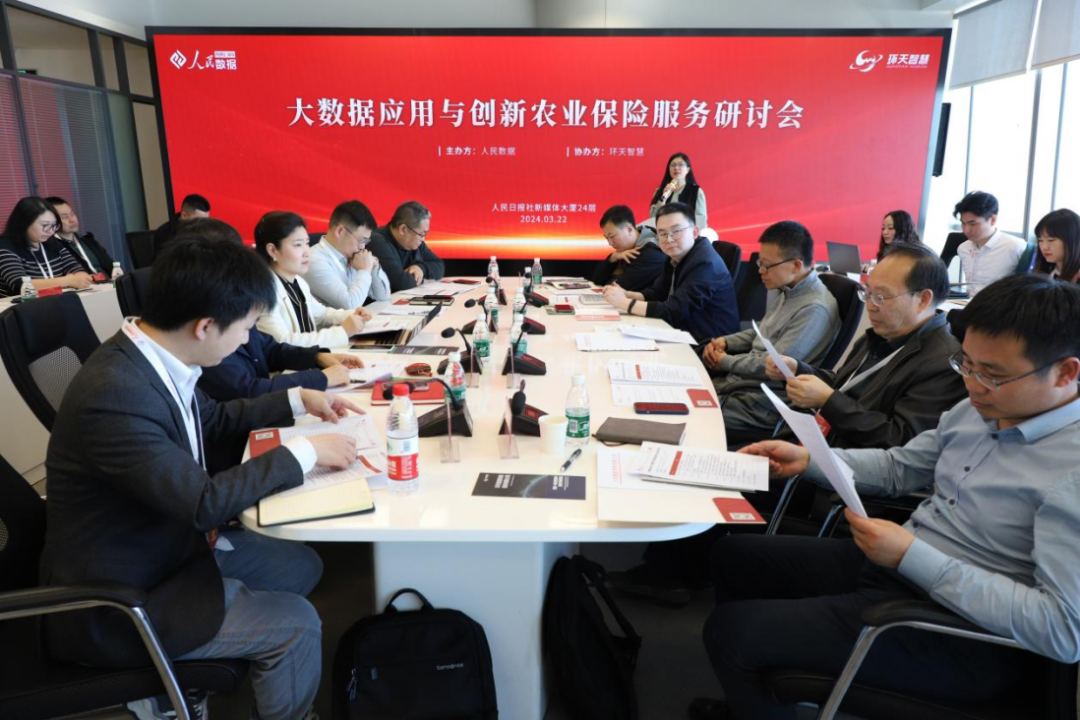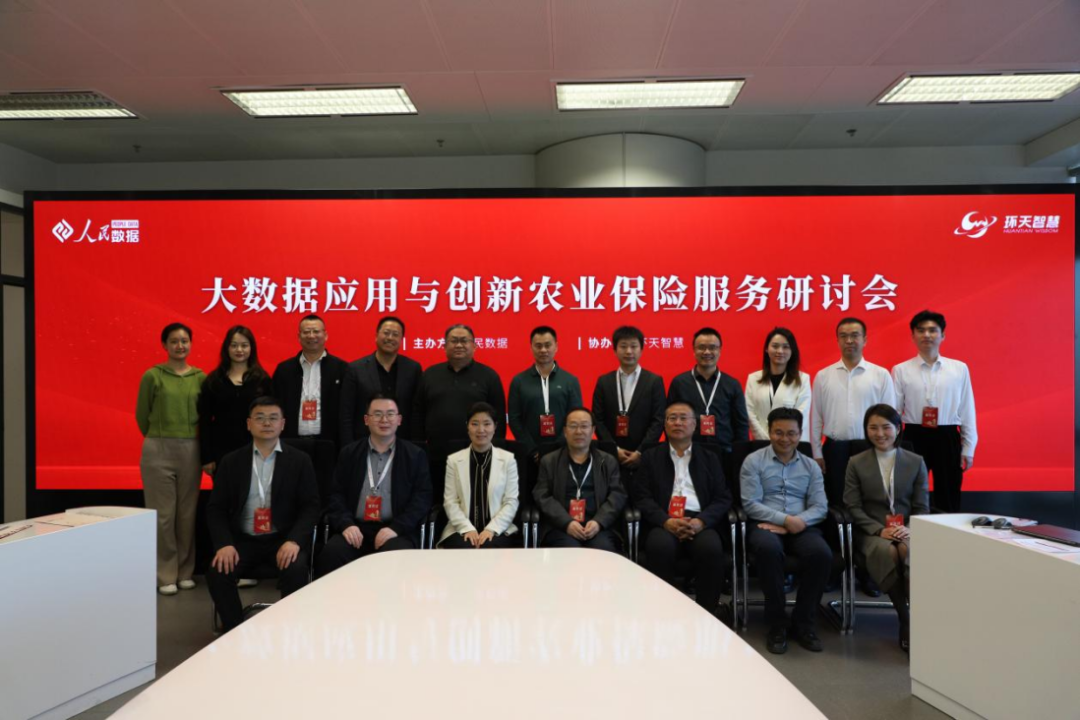
A few days ago, a seminar on “Big-data applications and innovative agricultural insurance services”, hosted by People Data and co-organised by Huantian Wisdom, was held at the People’s Daily New Media Building. The seminar focused on risks encountered in advancing rural revitalisation, difficulties in the development of agricultural insurance, and innovation in data applications.
In her opening remarks, Yang Senyan, deputy general manager of People Data, said that agricultural insurance, as an important means of spreading production and operating risks and of protecting agriculture, is one of the main policy tools with which the state supports agricultural development. In recent years, while agricultural insurance in China has achieved staged results, it also faces major challenges, including imprecise claims settlement, an incomplete service system and still relatively low coverage, all of which need to be addressed.
Zhang Yunhua, deputy director-general of the Rural Economy Research Department of the Development Research Center of the State Council, noted that rural areas now face many changes, the greatest of which is demographic: large-scale migration from the countryside to the cities, a deepening ageing of the rural population, and migration from the west to the eastern coastal regions.
Zhang Qiao, former director and chief scientist of the Agricultural Risk Management Research Center of the Chinese Academy of Agricultural Sciences, said that the basic institutions of agricultural insurance in China are gradually being improved, the course of development is becoming clearer, subsidy policy continues to be refined, the market system is developing in a healthy way, and technology-enabled digital agricultural insurance has broad prospects. Agricultural insurance has become a means for farmers to manage risk and protect income. At the same time, its development still shows “extensive” features: at the product level, products, pricing, underwriting and claims remain rough-hewn; at the level of government supervision and services, information is asymmetric and the tools of supervision and decision-making are limited. Big data, artificial intelligence and other technologies are urgently needed to make agricultural insurance more precise and to support high-quality development.
Yang Hao, a senior engineer at the National Engineering Research Center for Information Technology in Agriculture, said that satellite remote-sensing technology in crop farming can help make agricultural insurance underwriting and claims more precise. Remote sensing can support production-process management, monitor growth, provide early warning, and allow planting to be adjusted, reducing risk and disaster losses as far as possible and achieving “treating the disease before it arises” through risk reduction.
Wei Wei, deputy director of the Data Management Division of the Big Data Development Centre of the Ministry of Agriculture and Rural Affairs, introduced the Centre’s view of big data — that “small data are the real big data, living data are more sustainable, true data are more usable, and complete data are more valuable” — together with its main data resources and its exploration of applications in agricultural insurance. In advancing digital agriculture and rural development, the Ministry has built products including a public agricultural and rural big-data platform, the All-Agriculture Code, Nongshi Zhitong (Farming Direct) and a dynamic database of rural development, and will continue to improve its big-data capacity and the application of results.
Kang Ruofan, product director at Huantian Wisdom, said that as the volume and quality of remote technological means such as satellite remote sensing and unmanned aircraft grow rapidly, technology is gradually meeting the needs of the agricultural insurance industry. On the one hand, space–air–ground inspection can substantially reduce operating costs. On the other, as informatisation improves and industry standards are set, self-service and similar methods can reduce dependence on people at the execution level and lower the incidence of irregularities.